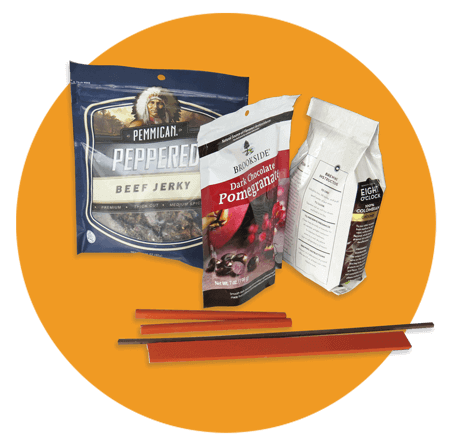
Tools coated with our thermally conductive silicone compounds are used all over the world, within a wide array of applications. If you are facing challenges with traditional tooling, such as metal seal bars, rubber coated rollers, or end of arm tooling grippers, chances are our custom approach may be the solution. This is especially true if your application calls for tight tolerances, high repeatability, and surface conformity.
An example includes modern packaging materials where typical metal on metal seal tools fail to create satisfactory seals. Another includes continuously heated rollers where adhesive layer between the metal and silicone surfaces fail. Our silicone coated tooling provides an alternative that helps integrators and OEMs achieve the results they need.
Markets that benefit from Silicone Tooling
- Industrial / Commercial
- Automation tooling such as robotic grippers
- Drive rollers
- Healthcare
- Tray and blister sealing for Dental, laboratory, medical, over-the-counter medicines and pharmaceuticals
- Food & Beverage
- Foil sealing for dairy, coffee, or juice packaging.
- Film and pouch forming often found in baked goods, condiments, fresh and frozen foods
- Part Decoration
- Brand logo application via hot stamping and foil transfer, often found in the cosmetic industry
Common Challenges Addressed with Silicone Tooling
Modern materials, faster production speeds, and sustainability initiatives are all placing greater strain on existing equipment. Our custom-designed silicone tooling—whether seal bars, rollers, dies, or grippers—helps manufacturers upgrade performance without overhauling entire systems.
We focus on plug-and-play solutions that integrate with your current hardware, extend the life of legacy machines, and keep your line moving.
Poor adhesion methods
Traditional rubber or silicone sheets utilize adhesives to mount the elastomer layer to the metal base. High temperatures or compressive stresses cause this adhesive layer to fail, delaminating the tooling. Our chemical bond will withstand these stresses, with failure occurring within the silicone layer before the bond.
Irregular seal surfaces
In heat seal applications, such as films and foils found on single serve food packaging, inconsistencies found on tooling surfaces or within the packaging materials can lead to poor seals that leak or result in spoilage. Our silicone layer is often able to conform to these inconsistencies, delivering a proper seal. If the silicone layer becomes worn or damaged, our ability to recoat results in lower repair costs compared to traditional metal-on-metal tooling.
Reliance on Teflon tape
In heat seal applications, especially when using metal on metal seal bars in conjunction with modern packaging materials, buildup forms on the seal tool face. Eventually this buildup impacts seal performance. The typical solution is to apply Teflon tape, which requires frequent replacement. Our silicone does not collect this build, reducing the need to disrupt production to remove and reapply Teflon.
For applications that still demand a layer of Teflon, we offer a silicone compound that features Teflon directly bonded to the sealing surface.
Food safety and hygiene
Food and pharmaceutical production environments demand heat-resistant tooling that’s also hygienic and easy to clean. Our bonded silicone surfaces are ideal for automated systems where metal-on-metal contact, adhesives, or Teflon™ tape can pose contamination risks or fail under washdown conditions.
Personalization and product differentiation
As personalized products and product differentiation become more common, production lines require faster and easier changeovers. Tooling must be accessible, quick to swap, and easy to maintain.
Recycle-ready, mono-material packaging
Mono-material lidding and flexible films are being adopted rapidly across the packaging industry. These materials demand more precise heat sealing, making optimized tooling essential for consistent performance.
Sustainable packaging initiatives are driving a reduction in plastic usage. Lightweight, minimal-material packaging must still perform reliably, placing greater demands on the quality and precision of the tooling used.
Common Applications using Silicone Coated Tooling
We think of our silicone more as raw material than a standard product offering. Due to our custom design and molding process, we tailor fit our tooling into your application. Here are some common ways others have found success with our materials. If you’re not sure your project’s a fit, connect with us for a call.
Nearly all the silicone coated tooling we support are custom designed for the application. Our application engineer works with you to understand operational parameters and dimensional / mounting requirements. Prototypes are recommended for appropriate testing. If you have existing tooling, we may be able to apply a layer of our silicone compound.
- Food tray sealing – high-speed, hygienic sealing of pre-packaged meals and single-serve containers
- Robotic grippers – non-marring tips for delicate handling in automated pick-and-place systems
- EV battery construction – silicone pads used in curing towers to apply uniform heat and pressure during adhesive curing for cell stacks and insulation layers
- Medical device packaging – precise, repeatable seals for sterile packaging lines
- Material handling rollers & deflecting pads – compliant, heat-tolerant silicone rollers and pads used for guiding, cushioning, or applying pressure to films, foils, molded parts, and fragile materials during transport or processing
- Cosmetic decoration – custom rubber dies for applying foil, heat transfers, and logos
- Legacy machine roller recoating – restoring performance on aging equipment no longer supported by OEMs
- Vacuum tables – used in automated assembly, inspection, printing, and thermoforming systems to provide stable, non-marring support with gentle part retention and even pressure distribution
- Stick pack and pouch sealing – for powdered, liquid, and dry fill packaging lines
If you're not sure where your application fits in, our engineering team can help evaluate your setup and recommend a path forward.