
What Are Modified Fittings? Everything You Need to Know
Understand what defines a modified fitting, the different types and benefits, and how you can get a fitting modified to your unique needs with insights from the ISM Product Team.

Imagine for a moment that you design and build robotic arms for complex machinery. These arms end in pneumatic grippers for handling a range of small items on an assembly line. But while these may seem like simple two-digit extensions, they require a complex assembly of tubing, valves, pistons, filters, and fittings to function optimally.
If that weren’t enough of a logistical nightmare, there’s the added matter of dexterity. And we’re not talking about the fun kind you level up in your favorite video game, but the kind that keeps you up at night wondering how you’re going to balance all those components with keeping your robotic arms lithe enough to do the delicate work they need to do at the speed at which they need to do it.
While there are a variety of ways to save space and reduce weight in pneumatic and other types of low-pressure systems, not the least of which involves your choice of materials, a somewhat underutilized method is to reduce the number of required components. No, that doesn’t mean cutting; it means combining these jobs such that your system can do everything it needs to do with less.
What Are Modified Fittings?
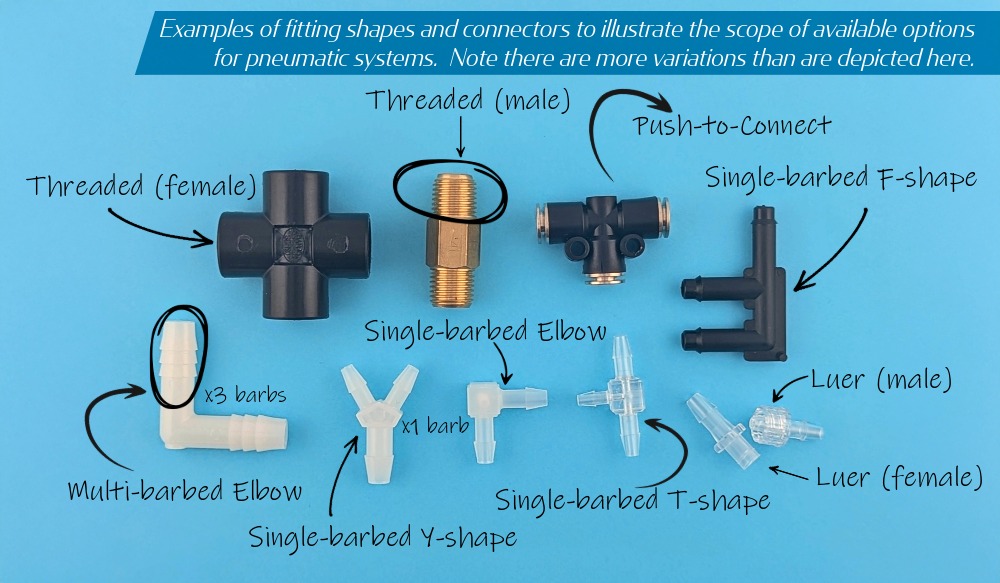
A fitting is a specialized component that joins parts of a fluid control system, be it tubing to other tubing, tubing to pistons, tubing to manifolds, fittings to other fittings, and so forth. In general, fittings are defined by their shape and the type of tubing connections they have at either end.
However, things get complicated when you have check valves and inline filters that also have these types of connections. A check valve with hose barb connections on either side, is both a check valve and a fitting. This is also true of filters designed for inline filtration.
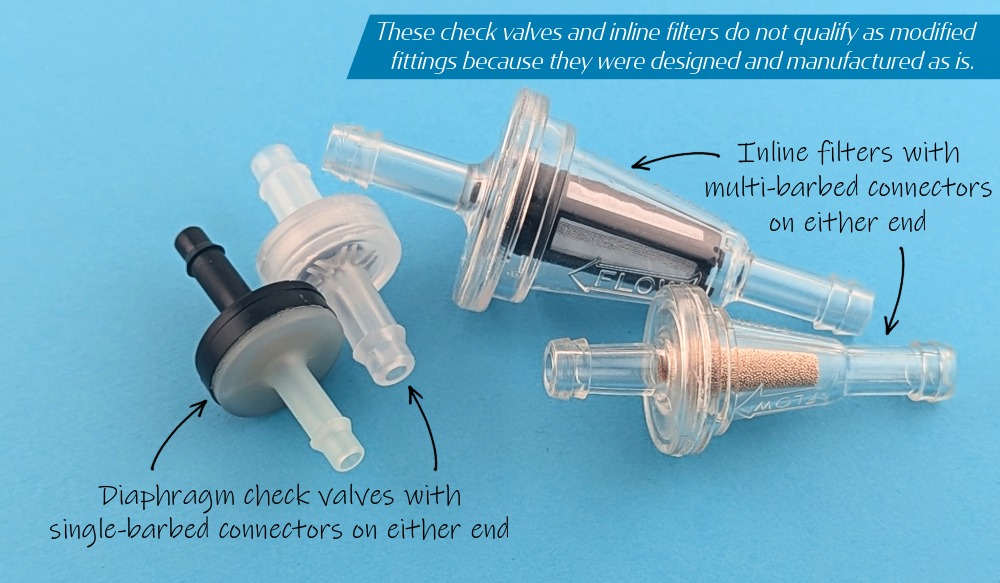
Ah, you’re thinking, this must be an example of the modified fittings that you speak of. Not quite. You see, a check valve that is designed and manufactured from the ground up to include hose barb connectors like those pictured above is not considered modified. They are manufactured fittings with integrated check valves. A modified fitting is defined by some sort of post-manufacturing modification. In other words, the out-of-the-box component does not quite do what you need it to do, so you change it. In the case of a check valve, you add a check valve cartridge to a fitting that did not previously have one or you modify the connectors on your existing check valve fitting.
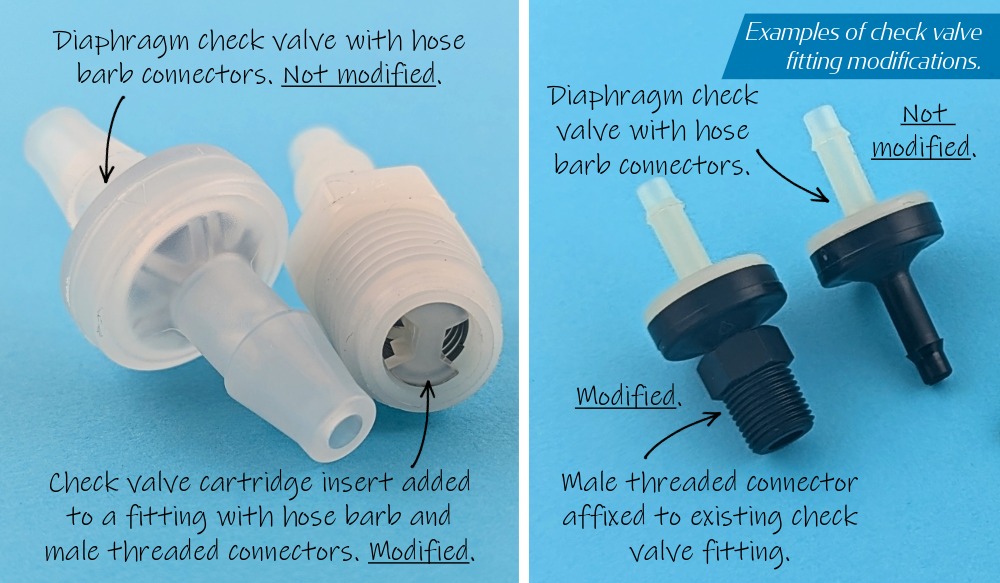
As you can see, the fittings above serve the same purpose when it comes to preventing backflow. However, the modified versions provide more flexibility in how these check valves can be incorporated into your system.
Examples of Modified Fittings
Modified fittings are not all check valves. A fitting can be modified for numerous reasons, including fittings that were already check valves to begin with. We’ve distilled them into three broad categories.
Modified Connections
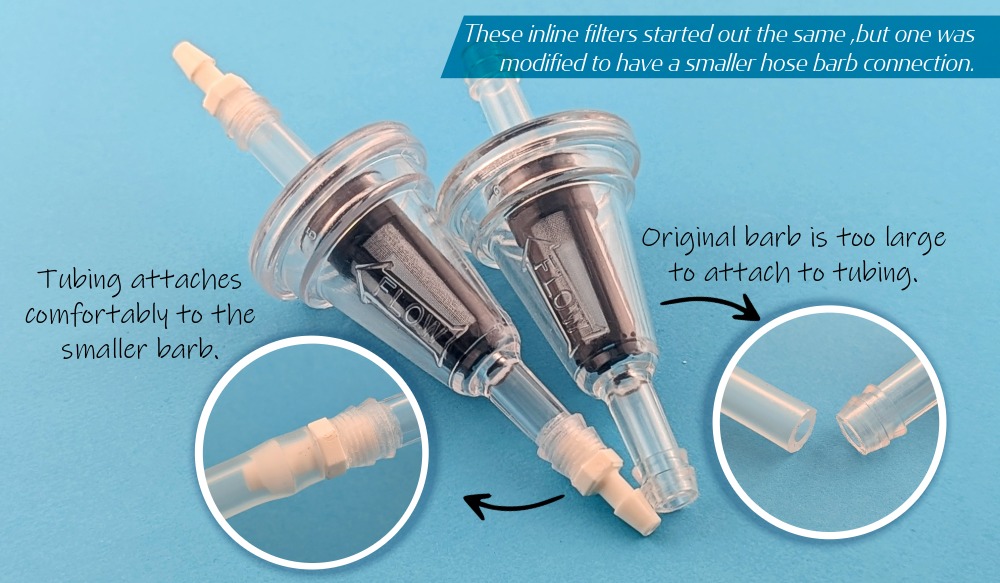
Let’s revisit your robotic arm. Your available check valves have single barb hose barbs on either side. Maybe they are too big for your tubing, but getting bigger tubing would add too much weight. Maybe you want more barbs for greater grip, but you can’t find the right kind of check valve with the right number of barbs. Maybe they’re just looking at you funny. But however, it happened, you’ve decided you need a different way for this check valve to connect those tubes. So, you add fittings on either side that connect comfortably to the check valve on one end and the tubing on the other. Easy peasy – if you have the right fittings.
Integrated Flow Control
Here is where the aforementioned inserted check valve cartridge lives right alongside relief valves and orifices. In short, you have a fitting that fits the bill (or tube as it were), and you need it to work harder. In goes the check valve cartridge to prevent backflow or the relief valve cartridge to protect against too much flow altogether.
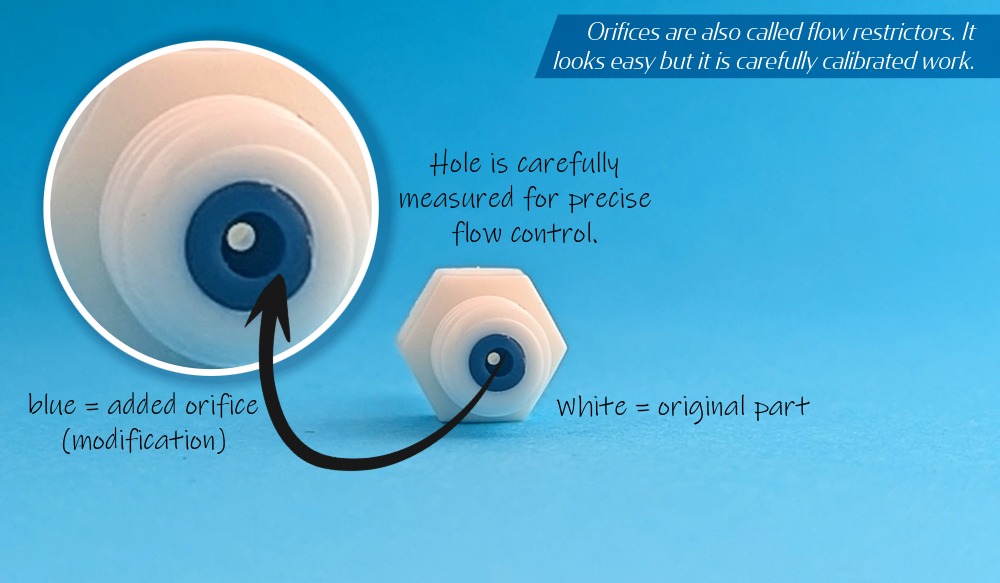
Orifice insertion is a little different. You’re not dropping a cartridge in. You’re adding a hole to a plastic or metal component that is then pressed into the fitting. But before you bust out your drill and go to town, you’re not adding just any hole. You’re adding a precisely measured and situated hole to help control the flow of air through your system. This hole serves to restrict flow as air enters and makes it easier to predict pressure changes.
Filtration
As with check valves, you can modify an existing inline filter, or you can modify a fitting by adding a filter. The principal here is the same: it’s modified if it occurs after the initial manufacturing process.
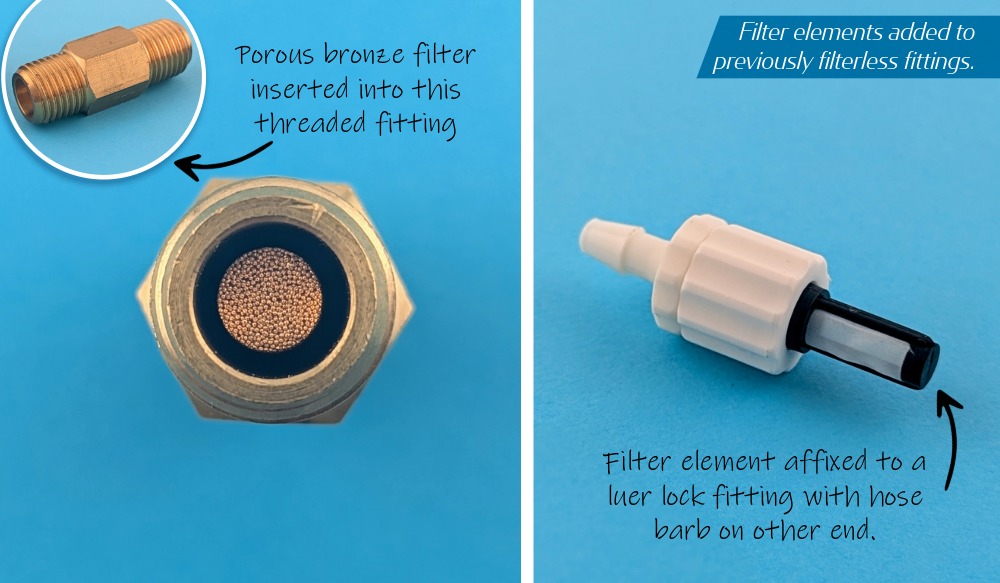
Adding a filter to an existing component is helpful for a variety of reasons. For one, filtering air in a pneumatic system keeps contaminants from gunking up the fittings, especially when those fittings are extremely small. It can also be helpful to combine your filtering capabilities with fittings that serve other purposes to limit the number of connection points in your flow control system, which leads us to our next question.
Why Modify Your Fittings?
Let’s recap and elaborate on the benefits we’ve already touched on.
- Not every connection type is compatible with every type of tubing. Get the connection you need by changing up how the existing ends of your fitting interact with your tubing. Fittings can be barbed, threaded, compression, push-to-connect, and so forth. Within these types, there are even more options, like the number and size of your hose barbs and the style of your threaded connectors. Furthermore, you may not have the option to change up the tubing, depending on the needs of your use case.
- Not every combination that is possible is immediately available. So why not just buy a part with the right connection? Presumably the connection isn’t the only factor. You also need the fitting to have the right type of filter or a check valve with the right cracking pressure. The exact match for your needs may be discontinued or may never have existed in the first place. That’s where your MacGyver instincts can step in.
- More connection points equal more potential failure points. While connections can be made very secure, nothing is going to be quite as leak-proof as an uninterrupted length of tubing. Unfortunately, that’s not going to cut it for your pneumatic system. Air needs to be filtered, backflow prevented, flow rates controlled, and so forth. That said, each point at which tubing is cut and affixed to a fitting introduces the potential for leakages, which in turn can lead to system inefficiency or even failure. Creating fittings that are multi-purpose allows you to keep the functionality while introducing fewer of these points.
- Precision control without the bulk. Needle valves are famously our friends when it comes to precision flow control. However, they can add bulk to your system. Orifice insertion allows you to precisely determine how you toggle flow through a fitting by simply giving the pressure a carefully designed escape route. You don’t add anything. In fact, you’re literally taking something away.
- Simplify assembly and maintenance. Fewer components mean less complicated assembly and easier maintenance. It also means your system will be lighter and take up less space, which is of chief concern to you and your robotic arms.
- Save money on component costs. Buy fewer components. Save more money. Of course this starts with finding the right supplier. Some suppliers have already modified components available. Others will work with you to design and build the component you need. ISM does both.
At this point, some people might ask why not just manufacture the thing you need from scratch? Certainly, some OEMs would be willing to work with you, no? You could absolutely do this, but ordering a fully customized fitting from an injection molding manufacturer is not like asking for extra cheese on your burger. These companies don’t just make the part, they make the machining that they need to make the part. That machining must be paid for, tested, and maintained. If there is not enough demand for this type of fitting, those costs will be passed on to you.
How Do You Modify a Fitting?
Let’s say you decide to save on space by integrating check valve and filter cartridges into the push-to-connect fittings that attach your tubing to the actuators that operate your robotic arm. How would one even go about starting that modification process? It’s certainly going to take more than some crazy glue and force.
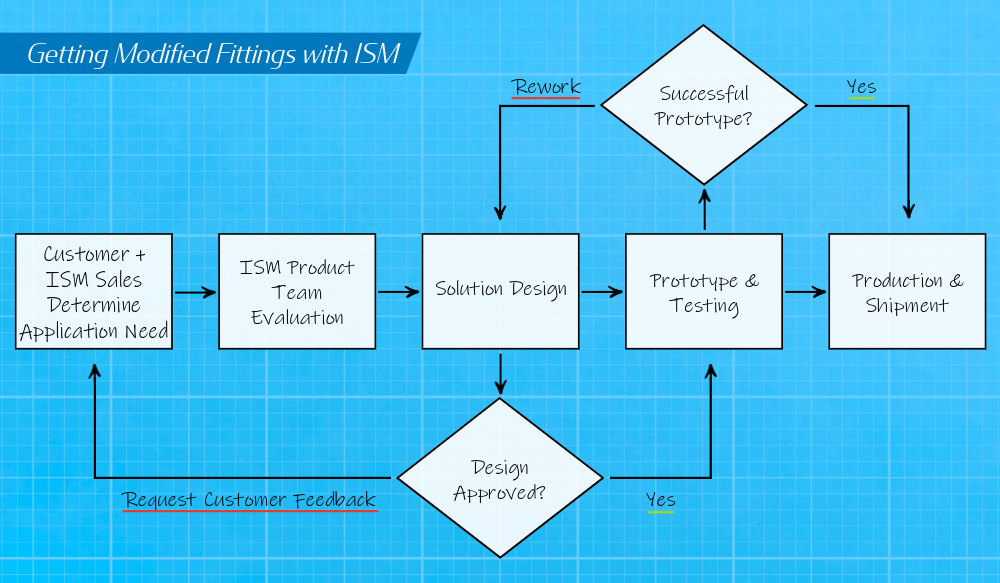
That’s where you turn to a supplier like ISM, who not only lists standard and modified fittings, but has a reliable process for fielding new needs and designing solutions to meet them. From the initial sales discussion through shipping, we help customers articulate their needs and design the right solution. We then assemble it ourselves.
Of course you don’t have to take just anyone’s word for it. Mike Elrod, Product Manager, and Josh Larson, Product and Integration Engineer, offer insight into the ISM modified fitting process and how our Product Team works closely with customers, salespeople, and technicians to make that process smooth and successful.
Step One: Call to Sales
You get on the horn and ring up your ISM sales rep with a new request. Maybe you’ve already deduced that you’re looking for a fitting with an integrated check valve and filter, or maybe you just tell them that you need to save on space and weight in the pneumatic system for your robotic arms, and you need someone to help you figure out how.
"Sometimes the customer knows exactly what they want. We get dimensional drawings, verbal descriptions, and hand made sketches or diagrams," Elrod says of the sorts of requests that result in modified fittings, adding "I have even seen sketches on napkins."
Larson notes that some customers come with certain specific needs but not necessarily the full picture. "Usually, they’ll come to us with something that’s a close fit, or they know what connections, flow rates, or cracking pressures they’re looking for."
Of course, before you get a chance to talk with the product team, your sales rep will have some questions to better define your needs, including inquiries about your application, material requirements, and internal media.
Step Two: Product Team Assessment
"We are brought into the process as soon as the sales rep gets off the phone or finishes reading the email request." Elrod indicates that the sales team wastes no time in soliciting support from Product. Together with the sales rep, Operations Manager, and Sales Manager, they form the Project Team for that request.
Larson adds that with more complex requests "the product team is usually brought in right away to assist in design and production and manufacturing feasibility." Conversely, some requests are simple enough that the modified fitting in question may already exist as a design spec or even physically in stock.
In either case, the Product Team continues the inquiry process, weighing your needs against available parts and modification options.
Step Three: Design and Testing
Let’s say the Product Team agrees with your assessment that using fittings with integrated check valves and filters will fit the bill, and there’s no existing modification design that will do exactly what you need. Now they work with you to design the modified part, taking into account pressure ranges, material needs, and component availability.
Larson notes just how much must be considered in part design. "Things I’m specifically looking for when we start the process are the estimated annual volume (EAU) for the part, the pressures and temperatures of the application, what medium (fluid) the part will be exposed to, and what the regulatory requirements might be." He places particular emphasis on the last part, acknowledging major differences between parts intended for medical or automative use cases and those in lower stakes environments. "Even if the function of the part is identical [to that of another], the application can dramatically change the product."
Newly designed parts are subject to in-house testing to ensure the solution is viable for customer needs.
Step Four: Assembly and Shipping
Once the design is finalized, a team of skilled technicians in our Production Department gets to work assembling the fittings, regardless of whether we’re talking about hundreds of thousands of parts or just a few dozen. Those parts get packaged and shipped upon completion.
Yes, you heard that right. Our modified fitting services include low minimums because we understand that specialty parts aren’t always needed in bulk. And you can always order more if the need arises.
Step Five: Completion
Ok, so this isn’t really a step. It’s more of a celebration of you having solved a complex pneumatic systems challenge. Getting from step one to step five can be a few days or a few months depending on a range of factors.
"A custom relief valve can take anywhere from a couple of days to months," says Elrod of the high variance in timeframes.
Larson agrees, adding that on average the process takes a month or two, but can be heavily impacted by modification complexity, part application and industry, and material availability. "It can be shorter for simple modifications where the customer has a good idea of what they need and the application isn’t too demanding. For certain industries such as medical or automotive the process can easily take several months to over a year from concept to delivered parts," he says.
Naturally, number of parts plays a significant role as well. The Production Team can produce an order of 30 parts much faster than an order of 30,000.
Evaluate Your Flow Control Needs
If you are truly working on robotic arms with pneumatic grippers, then you should already know how modified pneumatic fittings could help solve some of your trickier space and weight challenges. But most of you were just playing along, in which case you’re likely facing different challenges and may not yet know if a modified fitting would help.
The good news is, it costs you nothing to give us a call or fill out our contact form to have a dedicated discussion about your use case, your needs, and your bottom line. At ISM, we’re more than just suppliers; we’re partners in solving flow control challenges for businesses of all sizes.

Take Advantage of Our Expertise
We offer a line of ideas, so if you don't see it - ask for it. Let us turn your ideas for pneumatic or fluidic circuitry assemblies into reality — from conception to finished product.