
The Unique Challenges of Medical Component Design and Manufacturing
With Insights from Resenex
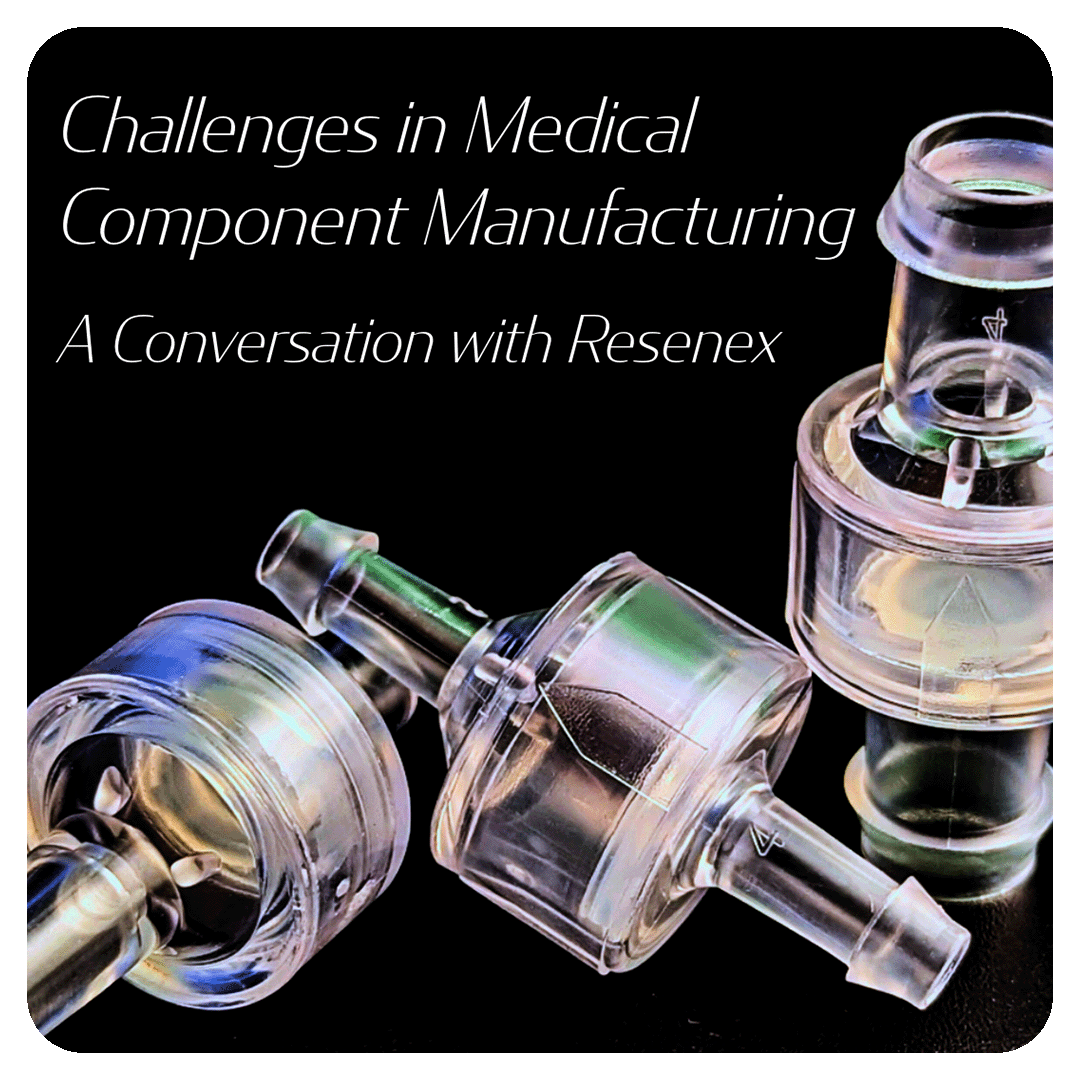
Medical component manufacturing sits at the intersection of precision engineering, material science, strict regulatory oversight, and a commitment to the unique needs of the medical and biomedical industries. Even familiar fluidic components like check valves, filters, and fittings need to be specially tailored and subject to tighter tolerances when the end user stakes are so high. OEMs of medical components like Resenex live these challenges every day and have developed innovative ways to tackle them.
Resenex is a specialty manufacturer of specific fluidic components for use in both medical and industrial applications. They’ve been perfecting this role since their founding in 1981 and continue to operate as a trusted brand in the medical manufacturing space since being acquired by Plastic Design Company (PDC), a precision injection molding manufacturer. Given their experience, we asked Resenex to weigh in on medical component design and manufacturing challenges.
"The top three challenges for manufacturing medical-grade components for Resenex are material selection and biocompatibility, maintaining regulatory compliance and standards, and precision manufacturing and quality assurance." Resenex says of the pressures that come with supporting medical device OEMs.
These considerations aren’t abstract either. They directly impact reliability, performance, and safety in real world medical applications. As Resenex puts it, "These are the pillars of regulation, material science, and precision engineering that form the patient safety for the high-flow medical-grade components that Resenex manufactures for medical component manufacturers."
With their help, we’ve explored these and other challenges in more detail, including ways that Resenex has sought to address them. So if you’re in the market for small parts for your medical device or fluid delivery system, find out more about how this arm of the industry works and why you want to source from a manufacturer that is knowledgeable and diligent.
Evolving Regulatory Requirements
Regulatory requirements for medical components are not uniform across the industry. Intended use plays a huge role in determining standards, especially when a component is meant to come in contact with bodily fluids. That said, even components that never so much as touch a patient are subject to strict standards. This gets exponentially more complicated when those requirements change or vary from one region to another.
"Resenex is facing evolving regulatory requirements that impact how the company presents itself to its customers and how it labels its medical-grade components.” Resenex speaks to the latest requirements on their radar, which they must evolve to meet. “For example, The European Union’s Medical Device Regulation (MDR) and In Vitro Diagnostic Regulation (IVDR) has placed increased emphasis on supply chain transparency."
Granted, they understand that such transparency is essential, benefitting everyone along the supply chain. The OEMs that use their parts need confirmation that those parts meet regulatory standards. In providing this confirmation, they too must have confirmation that the materials they use adhere to relevant standards.
What Parts Are Affected
Industry regulations affect all (or nearly all) parts, especially where medical requirements come into play. Concerns over plastics are twofold, coming from concern for both patient safety and environmental impact awareness.
Resenex notes that even basic resins used in injection molding are subject to strict and evolving standards. "The supply chain controls and quality assurance levels for these medical-grade resins will face increased levels of regulation over time, above and beyond the current standards." They acknowledge that this would have far-reaching implications for their products, identifying resins as their main component. "All of Resenex’s products could be impacted."
It stands to reason that all medical component manufacturers will face similar challenges as standards evolve. Plastics have come under fire as countries become increasingly concerned about forever chemicals used for manufacturing many types of plastics. Medical-grade plastics are not immune to this concern, but they remain among the safest and most accessible options for medical OEMs.
Possible Solutions/Strategies
Like many such companies, Resenex is facing these anticipated challenges head on, developing risk management plans for their medical-grade resins supply chain that includes "establishing closer relationships with their suppliers [and] developing relationships with alternate material suppliers."
Alongside diversifying your supply chain, medical component manufacturers can work with their suppliers and distributors to improve the transparency of their supply chain through close tracking and clear communication around compliance.
Biocompatibility
While regulatory requirements specific to medical component manufacturing cover biocompatibility, it’s worth addressing this challenge directly given its implications for patient health and safety. Concerns around biocompatibility come down to the fact that materials that otherwise look and feel similar have different qualities that come to bear in highly sensitive use cases.
Let’s take plastic leeching for example. All plastics leech to some extent, meaning they leak chemicals into whatever fluid is contained within or passing through them. However, some plastics leech more readily than others, and different plastics may leech different chemicals. But before you swear off every plastic container you see, remember that not all chemicals are inherently harmful or may only be harmful in certain situations. It matters if you plan to ingest the fluid or, among chief concerns to those in the medical industry, inject the fluid into someone’s blood stream.
Resenex highlights the relevance of these concerns to their product offerings: "Resenex manufactures a portfolio of high-flow medical grade components that are used in single-use fluid management systems in the medical device industry. The purpose of these medical devices is to bring fluids to or from the human body, and thus, the patient’s bodily fluids are in direct contact with the Resenex components, making the biocompatibility of Resenex components of paramount importance."
How This is Challenging
The example of intravenous fluids becoming contaminated through leeching is but one of a range of concerns. Some component materials may be too corrosive for certain fluids, so different medications or chemical compounds may react poorly to the plastics used in administering them. For example, some silicone tubing can cause certain drugs to oxidize, depending on how long the two are in contact. Transference can also happen the other way, with drug preservatives siphoning off into some types of tubing, decreasing that drug’s effectiveness. Put simply, interactions on a chemical level are complicated and often highly specific.
On the flip side of this challenge is the very real expense tied to medical-grade materials, which increases exponentially when you consider the need for single-use medical-grade components. These materials are held to a higher standard, and the components made from them subject to thorough sterilization, meaning they are costlier to create at just about every stage.
Possible Solutions/Strategies
Resenex already touched on one way in which the medical manufacturing industry works to ensure patient safety: single-use fluid management systems. These eliminate the added challenge of having to thoroughly clean and re-sterilize components. Resenex addresses additional concerns by “exclusively using only USP Class 6 biocompatible materials in all of its product designs [and] only using medical-grade materials that have a lot of traceability…," adding that “all products are shipped with a certificate of conformance, guaranteeing the product purity and correct material of origin."
It’s also important to consider how the end customer intends to use a given component or assembled fluid management system. For Resenex, this mostly comes down to medical vs bioprocessing applications. "Our medical-grade acrylic solution is most often selected by hospital use customers, because of the durability in single-use applications, [as well as] the familiarity and biocompatibility studies for medical-grade applications." They add that "for bioprocessing, polycarbonate is more frequently the selected material."
Additionally, they’ve designed their products to minimize potential failure points. "There are no gaskets nor O-rings, and no metallic elements nor adhesives in the Resenex design. [There’s] just a medical-grade silicone disc which has been used for over 40 years, with biocompatibility data from over 40 million medical-grade single-use applications globally."
Precision Manufacturing
Precision manufacturing is more than just the promise of high-quality output; it’s a defined process for creating parts that have very little room for error. We call this having tight tolerances. Often these tolerances are measured in just a few microns (one one-thousandth of a millimeter), meaning unacceptable defects may be difficult to spot with the naked eye.
The medical manufacturing industry demands this level of precision because the parts themselves are small and must perform optimally to ensure patient safety. Let’s take check valves for example. These components prevent backflow by only allowing fluid to flow through the valve in one direction. When used as part of a flow control system for administering intravenous fluids, it prevents contamination and facilitates controlled delivery. The smallest aberration in the finished product could cause the tubing to not fit quite right or the silicone disc to not close completely.
How This is Challenging
Clearly, it’s important that the manufacturing of these components be precise, but why is it so difficult?
Let’s start with the obvious: tighter tolerances have less margin for error. Machining must be precisely designed and meticulously maintained, including cleaning, checking alignment, monitoring temperature, and constantly checking output. This is expensive, time-consuming, and demands vigilance.
Digging down into the part about checking output, we find even more challenges. Quality control must be thorough and consistent. Oftentimes, this means checking individual parts from various batches multiple times a day. If a defect is found, then more parts must be checked and potentially entire batches disposed of. Machines may need to be cleaned, retooled, or otherwise maintained for improved results. But the more time dedicated to checking these parts, the more companies like Resenex are able to cut down on costly lost batches and ensure quality output.
Possible Solutions/Strategies
Precision injection molding allows for precise formation of small components en masse. The precision molds themselves are frequently made using CNC (computer numerical control) machines to carefully craft the steel or aluminum molds, often also including features like cooling channels and vents, both of which contribute to higher-quality output. CNC machines can also be used for iterative prototyping in the initial design of components and the molds that make them.
Contamination Risks, Sterilization, and Cleaning
Contamination, sterilization, and cleaning are related to but distinct from biocompatibility. While materials that aren’t biocompatible may lead to contamination, concerns over contamination are broader. Contamination can be caused by a part being dropped on the floor, being handled by unwashed or ungloved hands, or just not being sterilized properly. As such, even biocompatible materials must be subject to thorough cleaning and sterilization to prevent spreading illness or causing potentially fatal injury.
How This is Challenging
Contamination can happen easily and may not be so easily spotted. While you might spot discoloration or physical debris, there’s a good chance you won’t notice the contamination until you see signs of it in a patient, at least where intravenous applications are concerned. Contamination is also insidious. It not only makes once clean parts no longer fit for their intended medical use, but it can also spread, contaminating parts that come into contact with the initially effected part.
Of course, the natural method for combating contamination is sterilization, but that too comes with challenges. Not all materials are well suited to all forms of sterilization, so you’ll want to ensure that your method is compatible with your material.
Additionally, sterilization can only get you so far. According to Resenex, "The bioburden and particulate matter on the medical device must be sufficiently low prior to sterilization, such that the sterilization cycle effectively reduces the remaining bioburden to low levels for patient safety." Therefore, part cleanliness is a factor in effective sterilization, which is itself challenging when you’re working with very small parts.
Possible Solutions/Strategies
The act of cleaning and sterilization is both the challenge and the solution. You just need to know what methods work best for your parts and make sure you tackle the challenge from all angles.
Medical component manufacturers like Resenex will conduct their precision injection molding in clean rooms to start each part off with as little bioburden as possible. Additionally, assembling flow control units and packaging parts is best done in a clean room to prevent introducing particulate matter to those parts prior to sterilization. ISM’s ISO 8 Class 100,000 clean room is used for packaging and assemblies for medical use cases, including Resenex parts.
Even with all that care, parts still need sterilization prior to use in a medical setting. Manufacturers will have chosen materials that can hold up to sterilization, but the method still matters. Heat resistant materials respond well to steam sterilization, for example, while metal responds well to dry heat sterilization and vaporized hydrogen peroxide or ethylene oxide works well for materials that are heat-sensitive. Resenex commonly uses "either ethylene oxide or gamma radiation".
Finally, there’s the matter of SUTs (single-use technology), which must go through these initial steps but does not need to be cleaned post use and re-sterilized. For pre-packaged SUTs, even the packaging must be sterile. According to Resenex, "Medical devices that are used in single-use fluid management systems are provided in a sterilized packaging configuration, usually Tyvek."
End-Customer Error
Then there’s the simple fact that you can do everything right, and there could still be risk to patient safety. Medical settings can be highly stressful with professionals working long and late hours. That compounds with the reality that even the best of us make the occasional mistake. Unfortunately, mistakes in this case can cause serious illness or death. Medical component designers have taken it upon themselves to specifically design these parts to mitigate this sort of error, giving hospitals added peace of mind.
"End-customer error is a primary consideration for medical device design teams when developing single-use medical devices." Resenex emphasizes single-use in part because devices and components that have direct patient contact are more likely to be single-use, and it’s these that pose the greatest risk to the patient.
What Considerations Are There?
"One of the main risks and end customer errors is a dropped component or fluid line," says Resenex of concerns they’ve specifically anticipated and accounted for. "This scenario is common because there are many lines to manage in a crowded hospital setting, and because the clinician must wear gloves, which reduces their manual dexterity…The fluid lines are also often made of thick tubing with a large bend radius, which can also cause the line to spring back and become accidentally dropped."
Dropped lines become quickly contaminated, making them unsuitable for the task being performed. Suddenly the medical technician is rushing to replace the line in a setting where time is a vital resource.
Other common errors include incorrect pairing of patient lines. With so many similar connection types, it’s easy for tired medical technicians to attach two that technically fit but shouldn’t be connected.
"Many fittings use a standard luer connection, which is a more universal connection," Resenex says of the frequency of these connection types. "This risk of a universal connection is that a clinician could accidentally connect the wrong line to a patient and cause an error, injury, or death."
Possible Solutions/Strategies
Resenex has just the ticket for preventing dropped lines and even accidental disconnections. "Our shield connectors are a proprietary design, and they help clinicians by protecting from accidental disconnection. The tethered cap is designed to prevent the line from being dropped."
They are referring to their large bore shielded connectors and caps, adding that these parts are also designed with an eye toward how clinicians typically operate. "[the tethered cap] allows the clinician to disconnect and reconnect the line with one hand, improving the ease of operation, because they can manage the opposite fluid line with their other hand."
As for incorrect pairings, many OEMs of medical components are finding ways to efficiently differentiate fittings. Resenex mentions "a custom thread pitch” that keeps the threads from two fittings from properly catching. “By incorporating a custom pitch to a threaded connector, such as the Resenex shielded connectors, the clinician cannot accidentally connect the wrong fitting’s fluid line to the patient."
Resenex Solutions
It’s clear that as experts in the field of manufacturing, Resenex both considers, and accounts for, the various challenges identified in this piece. Their lineup of highly specialized proprietary medical flow control components speaks to that commitment to innovation and customer-centric design.
Medical Check Valves
Resenex high flow check valves come in both straight and barbed end fittings at a range of sizes. Using a "proprietary medical-grade silicone disc that opens at only .1 PSI," as Resenex puts it, these check valves are specially designed for use cases where having uninterrupted forward flow is essential. "This reduces turbulence and shear forces to blood and other biological fluids, which is considered beneficial to clinical applications."
Of course, having such low cracking pressure can raise concerns over backflow, but Resenex has an answer to that as well. "The design is simple, with low opening pressure but also with robust protection against back-flow." Resenex check valves are 100% tested for back flow, demonstrating a positive seal even when back pressure is low.
In addition to the low cracking pressure, the check valves are designed for high flow "due to the larger cross-sectional area compared to competitors," Resenex adds. "This is beneficial because it enables a faster fluid delivery rate for various single-use fluid management applications where flow rate is important, such as waste management, drug delivery, renal care, enteral feeding, and bioprocessing."
Shop Resenex High Flow Check Valves
Shield Connectors and Caps
Shielded connectors facilitate high flow by having a large bore, or internal tube diameter. The shield around the bore prevents contamination and provides easier gripping for medical staff. Resenex designed these connectors for a combination of ease and safety, given the fast-paced but highly sensitive nature of medical settings.
"They are similar to luer connections because they have a twist-lock design that prevents accidental disconnection if touched by a patient or clinician," Resenex says of this proprietary design, "and yet can be disconnected by a nurse with one gloved hand, which makes the operation of the connector a familiar and user-friendly design for the clinician."
These connectors pair well with the tethered caps, which add to the safer, more user-friendly design. Both come in medical-grade acrylic and a range of dimensions.
Shop Resenex Large Bore Shield Connectors and Caps
Resenex and Biocompatibility
Similar to ISM, Resenex supports OEM manufacturers of medical-grade equipment "in an ISO Class 8 clean room environment." Additionally, they use "only medical-grade materials with biocompatible materials that are USP Class 6." These materials are also rated for ethylene oxide and gamma radiation, meaning they can withstand said radiation, making them well-suited to those methods of sterilization.
It's worth noting here that while both Resenex and ISM handle these components with care, limiting exposure to particulate matter via clean rooms, neither company performs full sterilization themselves. Rather, the parts are considered well suited to sterilization given the materials involved and the efforts to mitigate bioburden.
Similarly, Resenex emphasizes that they make components for use in medical devices, but they are not the manufacturers of said devices. As such, it’s up to the OEMs that purchase their parts for manufacturing medical devices to validate the performance and safety of that device. "The advantage of this for medical device manufacturers is that they have higher confidence that their validation testing will pass biocompatibility testing due to material selection of their medical device components," Resenex says of the added value their parts bring to the manufacturing table.
The Resenex and ISM Advantage
Of course there’s more benefit to Resenex components than just the USP Class 6 material they’re made from. As we’ve already illustrated, Resenex component designs are optimized for medical use cases with special consideration paid to common challenges and the ways in which medical providers handle these components in a real-world setting.
As the master distributor of Resenex components, ISM also pays careful attention to proper handling of these components, including assembling, kitting, and packaging as needed in our clean room environment.
Learn more about ISM cleanroom capabilities or shop now for your medical component needs.

Take Advantage of Our Expertise
We offer a line of ideas, so if you don't see it - ask for it. Let us turn your ideas for pneumatic or fluidic circuitry assemblies into reality — from conception to finished product.