
Texas Tech Case Study: How ISM’s Versatile and Flexible Component Offerings Helped a Research Team Turn Entrepreneurs
Thanks to the versatility and accessibility of ISM’s product offerings, Texas Tech’s Canine Olfaction Lab is revolutionizing canine scent training and research.
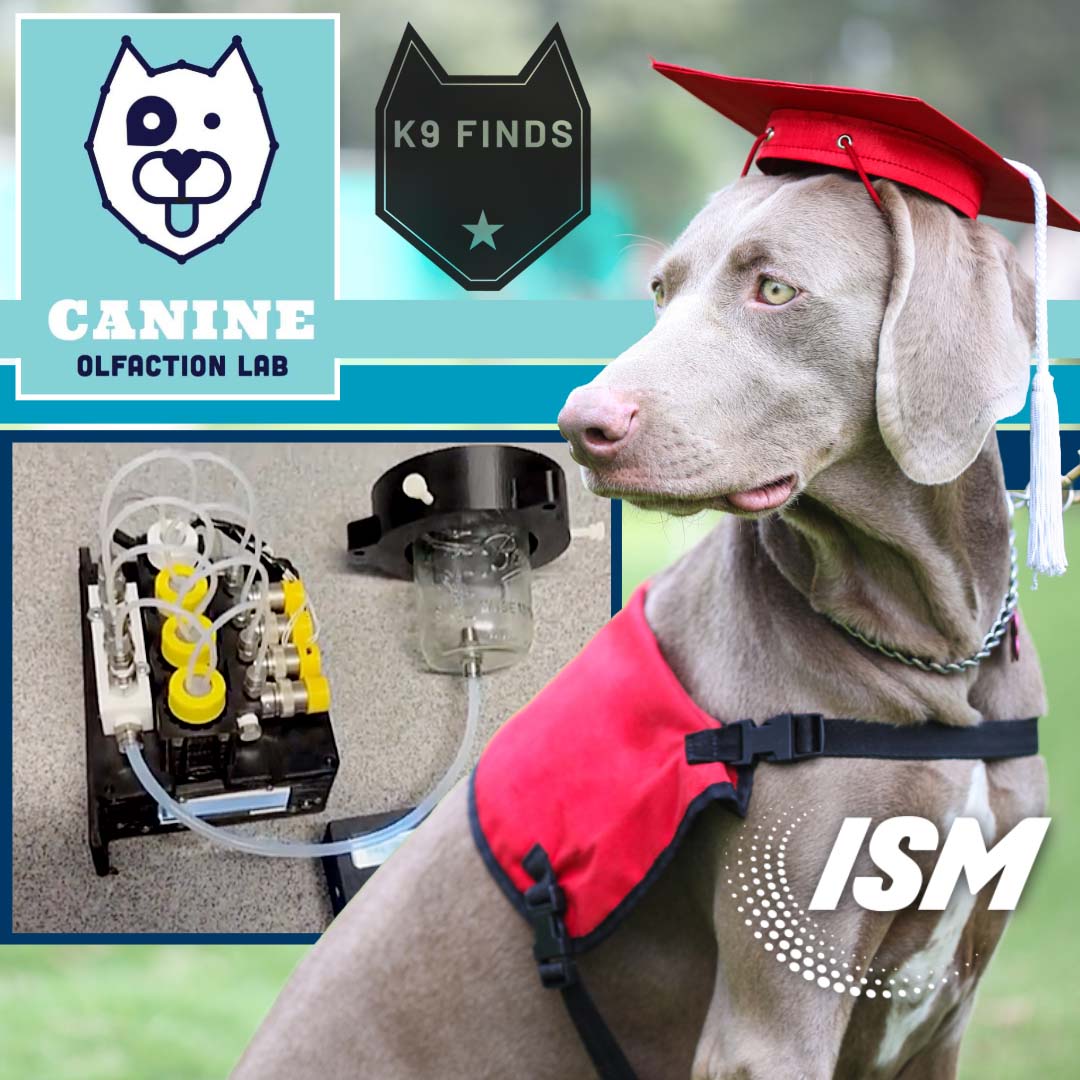
Nathan Hall wants you to adopt a dog. More specifically, he wants you to adopt one of the many dog participants in his ongoing research into canine olfactory capabilities and how they are influenced by training.
As Associate Professor of Companion Animal Science and Director of the Canine Olfaction Research and Education Laboratory at Texas Tech University, Hall’s main focus is to further our understanding of canine behavior, learning, and scent detection and how the three interact. As a dog-lover, he conducts his research humanely, with lots of pets and treats, and actively seeks to find dog participants forever homes in the local community.
Now, 13 years into his research, Hall and his team have not only advanced canine behavioral sciences, but also developed and tested a device that introduces more precision and accuracy into canine scent training – a device that you don’t have to look too closely to see is chock-full of ISM components.
Overview of Their Research
Picture this: a dog is nosing around a small facility, sticking his face in various cavities along a wall. Each cavity produces a different scent, one of which is the “target scent” that researchers want the dog to identify. Behind each of these cavities is a device comprised of a manifold, push-to-connect fittings, check-valves, needle valves, and more. The entire setup is affixed to the back of the wall behind their respective cavity via a bulkhead connector.
This may look like a training session, but it’s much more of a research facility than a classroom. It’s also just one of several experiments Hall and his team conduct in an effort to better understand how and how well dogs detect certain scents.
"Right now, we have about 4-5 projects going," Hall notes at the time of this interview. “There’s a project testing whether dogs can detect powdery mildew.” Hall is referring to a fungus that grows on grape crops. The project’s goal is to determine if dogs could be used to help prevent the spread of this fungus.
Other projects include the exploration of how exercise can negatively impact olfactory capabilities in working dogs in order to mitigate those effects. They also work with dogs to determine the lowest possible concentration at which a scent can be identified.
"I’ve been doing this for 13 years," Hall talks about how he started in grad school, earning his PhD in Experimental Analysis of Behavior. “Part of that was understanding human and animal behavior,” he says of this particular branch of psychology, "and through that I became interested in dog sense of smell."
Hall notes that while humans have been leveraging canine olfactory capabilities for a long time, there’s been woefully little formal research on the subject, limiting insight into what types of scents dogs can detect and how. "Our research aims to better optimize training and explore new potential applications of that training through greater understanding of not just what dogs can do, but how they do it."
Specific Challenges
If you thought teaching your dog basic commands was difficult, it’s got nothing on scent training. Many training efforts lack sufficient controls to accurately determine if the dog is indeed picking up on the right odors. Over the past decade plus, Hall and his team have run up against a handful of challenges that the aforementioned device is specifically designed to overcome.
For starters, it turns out that some dogs are smarter than their noses. As Hall explains it, "Dogs can pick up subtle cues from the handlers, so if the handler knows where the odor really is, the dog will too." In other words, the dog won’t bother using his nose if the answer is written all over the handler’s face, and it’s not always easy to tell if that’s what’s happening. The solution? You need a system where no one knows where the odor will be.
Dogs also rely on memory to shortcut their way to the right answer. Hall notes that the location of the target odors needs to move around in order to properly test and train the dogs. However, this can be a laborious task. Hall notes that in a space full of bags, one of which contains the target scent, "People end up just moving the target odor, and the dogs can track which [bag] was moved." The obvious solution seems to be when moving scents to not take shortcuts, so the dogs can’t either. However, Hall and his team explored more efficient and less taxing ways to accomplish this, as small research teams might find the former easier said than done.
Another tasking effort prone to human error is data collection. Where some researchers might rely on timers, notes, and video playback to gather data for entry and analysis, Hall and his team have sought an approach that’s both more efficient and more nuanced.
Finally, there’s the practical matter of odor contamination. The simple fact is that odors are everywhere, many of which are undetectable by people. It’s difficult to ensure that a given odor is not contaminated by other odors such that it might cause confusion. Even the dogs themselves can contaminate odors if their noses come in contact with the source. Meticulously cultivating, administering, and protecting the integrity of these odors was among the biggest challenges Hall’s team faced.
ISM’s Role in Their Solution
Over years of research, Hall and his team faced and addressed these challenges head on. Their efforts resulted in the K9 Olfactometer. Each of these devices carefully curates a specific odor and administers it via pneumatic tubing to a designated location, typically one of several cavities in a wall, as in the description above. These devices are also specially designed to prevent contamination, randomize odor locations, and gather data for immediate analysis.
Of the more interesting and complex aspects of this device is the way it combines chemicals to create common and seemingly unrelated scents. "Take the smell of a strawberry for example. If you sniff a strawberry, you’re detecting about 200 different chemicals, as well as complex interactions between chemicals." Hall explains that you don’t need a strawberry to create a strawberry scent. "You can take a pure chemical that smells like different things mixed together, and you get the perception of something totally new."
Of course, specialty devices often require specialty components. Many such components in the K9 Olfactometer came from ISM’s varied catalogue and serve an important purpose in addressing the challenges outlined above.
- Bulkhead connector – Affixes the device to the wall near the associated cavity through which the dog receives the scent.
- Teflon manifold – Manages the collection and distribution of chemicals to form the necessary scents. Teflon helps prevent contamination of those scents as it is less likely to leech.
- Teflon manifold – Manages the collection and distribution of chemicals to form the necessary scents. Teflon helps prevent contamination of those scents as it is less likely to leech.
- Teflon tubing – Similar to the manifold, the tubing helps manage the flow of the scents, and the Teflon protects their integrity.
- Push-to-Connect fittings – By having tubing that’s easy to connect and disconnect, devices can be assembled and adjusted with ease.
- Piston check valves – Prevents backflow, which also helps protect the integrity of the scent even as a dog sniffs at the wall cavity.
- Needle valves – Allows precision control over the amount of different chemicals entering the system, which is necessary to curate the correct scents.
- Flow meters – Measures gaseous movement for improved control and monitoring.
Put simply, the device carefully combines chemicals to create uncontaminated (pure) odors and delivers those odors through tubing to one of several cavities on the other side of a wall. Each cavity has an associated device, and the assigned odors are randomized by a computer. The dog sniffs at the cavities, identifying the one with the target odor. If the dog is correct, a green light turns on. The computer tracks and stores data for analysis, including scoring dogs on their level of success.
Of course, designing such a device was no simple task. It went through several iterations as Hall and his team refined it. "This current version has been refined over many hair pulling moments of dogs learning cheats in other systems." Hall illustrates their frustrations, specifically citing a time when a dog learned he could push a valve on one of the earlier device iterations, and if it moved, he knew it was delivering the target odor. “In that case,” he adds, "only the target system had a back pressure valve, and the dog was triggering this valve by adding pressure."
So naturally, Hall’s journey in developing this device was not as simple as making a list of needs and buying in bulk from manufacturers. He needed to test out a wide range of small parts, building numerous versions over time. That meant finding a small part supplier as varied and flexible as their process.
Experience Working with ISM
Hall found us online back in 2015 "before Amazon carried everything" as he puts it. At the time, the choice was simple. "You were half the price of where I could find things elsewhere unless I wanted to buy hundreds of something." Hall points out the unique challenge of shopping for specialty flow control components when you’re not buying in bulk.
But it was the size of ISM’s catalog, including varied material options, that kept him coming back. As a distributor that works with a wide range of OEMs, ISM doesn’t just offer check valves, for example, we offer diaphragm, ball, high flow, duckbill, modular, and more. We also offer them in a range of plastics and metals with various connection types and sizes. Finally, we make them available in smaller batches with faster turnaround times.
"When you’re inventing something, you’re trying this out and that out," Hall says of his experience developing the K9 Olfactometer. "It helps to have a wide range of options to test and try. Sometimes, I’d order a bunch of different parts at once that I could functionally test out to see what works. It made it possible to trial and error without spending a ton of money and time."
Hall also notes that material variability was another big reason he stuck with ISM. "I could find a lot of the components I needed in brass, but to find them in stainless steel was harder unless I went directly to an OEM and ordered in bulk." Stainless steel, like Teflon, was an important feature in preventing odor contamination.
"I appreciate the ease, speed, and flexibility I get from working with ISM. It’s been a reliable constant in an otherwise complex exploration to find the best way to reliably study canine olfaction."
Looking to the Future
Hall further notes that the journey is not over. "It’s still quite a bit of a black box," he says of the mysterious nature of the olfactory sense. He acknowledges the possibility that the device itself may continue to evolve. However, it’s reached a stage where its success has garnered some attention and popular demand, inspiring Hall and his team to take their work on the device to the next level.
"We’re getting demand in the dog training industry," Hall says. "People are wanting them because they solve a wide variety of issues." Hall cites the above issues, including the relentless intelligence of the dogs themselves as they’ve found creative ways to circumvent various methods.
As such, Hall and his team are in the process of launching a spinoff company, K9 Finds, where they make and sell more of these devices while continuing their core research. So, if you’re in the market for the best way to scent train dogs, join their mailing list to learn more. If you’re looking for a simple and easy way to get a wide range of pneumatic and fluidic parts for your own efforts, explore ISM’s expanding catalog of options.
And if nothing else, consider reaching out to the Canine Olfaction Lab and adopting one of these clever pups.

Take Advantage of Our Expertise
We offer a line of ideas, so if you don't see it - ask for it. Let us turn your ideas for pneumatic or fluidic circuitry assemblies into reality — from conception to finished product.