
How to Choose an Inline Filter: 5 Key Things to Know
Refreshed May of 2026
If you think finding an inline filter is easy, then you may not be asking the right questions. This is doubly true if you need a miniature inline filter. But where do you start if you’re not even sure which questions to ask? After all, you don’t know what you don’t know, right? Before you open a tab and start Googling (or maybe you did and that’s why you’re here), allow me to spare you the noise. The following considerations won’t tell you outright what filter you need, but they will help you understand what’s important and why.
1. Particle Separation
Filtration is the separation of particles from a liquid or gas stream. Before choosing a filter, you need to understand what kind of separation your application demands.
- Gas from liquid — Do you need to remove bubbles from your hydraulic system? Bubble cavitation can lead to erosion in some components, which in turn threatens the efficiency and integrity of your entire system. In some medical applications, bubbles can be life threatening if injected into a patient.
- Liquid from gas — Do you need to remove moisture from your pneumatic system? Moisture can corrode components, potentially leading to system failure. Systems that require food-safe practices risk introducing bacteria via unnecessary moisture in the system.
- Solid particles from flow — Do you need to remove debris from either of the above? Put simply, that delicate diaphragm check valve won’t work as well with debris lodged in its mechanism.
Not all filters handle particle separation in the same way, and those differences matter when it comes to your specific filtering needs. Filters vary by filtering element; like mesh, depth, or membrane; pore size, material, and more.
2. Filter Element
Your filter element is that part of your filter that does the dirty work. And by that we mean, of course, stops things like dirt getting into your system and damaging your sensitive components. These elements can differ on a handful of measures, the most common of which are described below. However, in order to figure out which one is best for you, you’ll need to interrogate your own application needs.
Surface vs. Depth
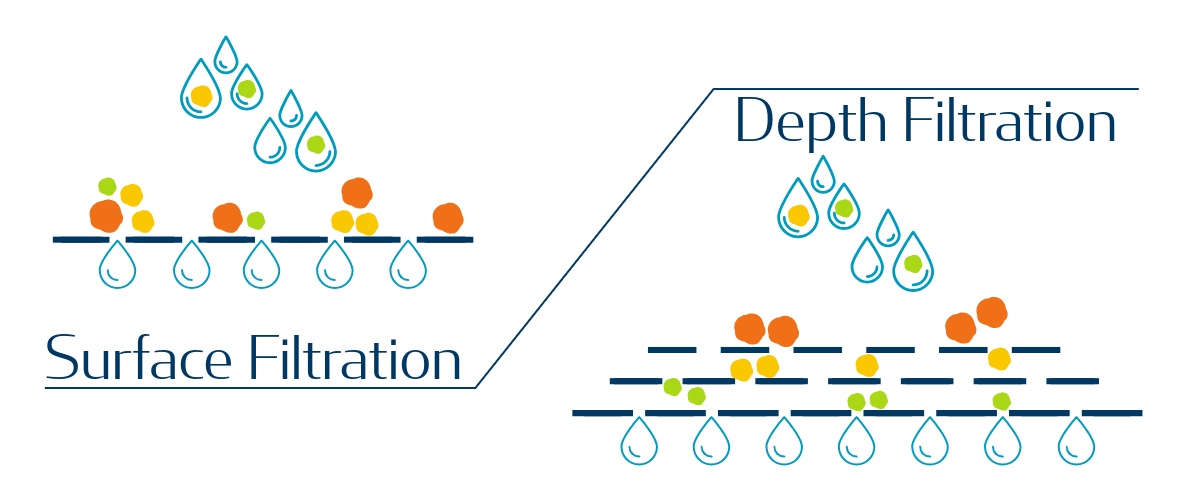
Surface filters operate using a mesh or membrane. They block particles at their surface. Picture pouring rotini in boiling water into a kitchen strainer. The rotini stays in the bowl while the water passes easily through.
Depth filters use a more dynamic approach, funneling particles through layers of filter material and trapping unwanted elements of varying sizes at various points. Now picture pouring your boiling hot rotini into a sink filled with packing peanuts. The pasta isn’t on the surface anymore. It’s buried in the packing peanuts at various depths.
Now it’s worth noting that those broken bits of rotini that might escape through a traditional plastic strainer are almost certainly caught somewhere in the packing peanut sink, so you’ve cast a wider net and filtered more out. However, good luck cleaning your sink (and eating your pasta).
Mesh vs. Membrane
Mesh filters (aka screen filters) are essentially tiny strainers, letting the easy stuff through and blocking the stuff that can’t fit. The smaller the pores, or openings in the filter element, the smaller the particles it is able to block. Easy to clean but less refined, this is a decent option for prefiltering or simply cases when what you’re filtering for is more robust.
Membrane filters function similarly to mesh filters, in that they are surface filters, but with microscopic pores for filtering out extremely small particles as opposed to a woven mesh. So if the mesh is a like strainer, the membrane is like your skin, absorbing things like topical skincare products while keeping bacteria at bay.
Membrane filters are excellent for precise filtration but not as durable nor as easy to clean. In fact, they are often single-use devices for that very reason. Consider these in cases where what you’re filtering for is extremely small (or microscopic) and when having a thoroughly clean system is more important than an easier to maintain filter element. These more delicate filter elements are vulnerable to clogging or damage by larger debris.
Sintered vs. Spun Fiber vs. Pleated
Not all depth filters are limited to these three common types, but much of what you’ll find in the world of miniature inline depth filters will be either composed of spun or pleated fibers or sintered materials.
Sintered filters are made from more durable, hardened materials like bronze, stainless steel, or engineering plastics. This makes them a better option for higher pressure applications where filter element damage is of greater concern.
Spun fiber filters are softer and more absorbent and typically made from polypropylene. They are used in lower pressure environments, often to remove particulates from water or moisture from air.
Pleated filters are similar to spun fiber in that they are softer and more absorbent, often made from cellulose or polyester. They offer a greater surface area, which makes them better suited to applications with high filtration demands.
Hydrophobic vs. Hydrophilic
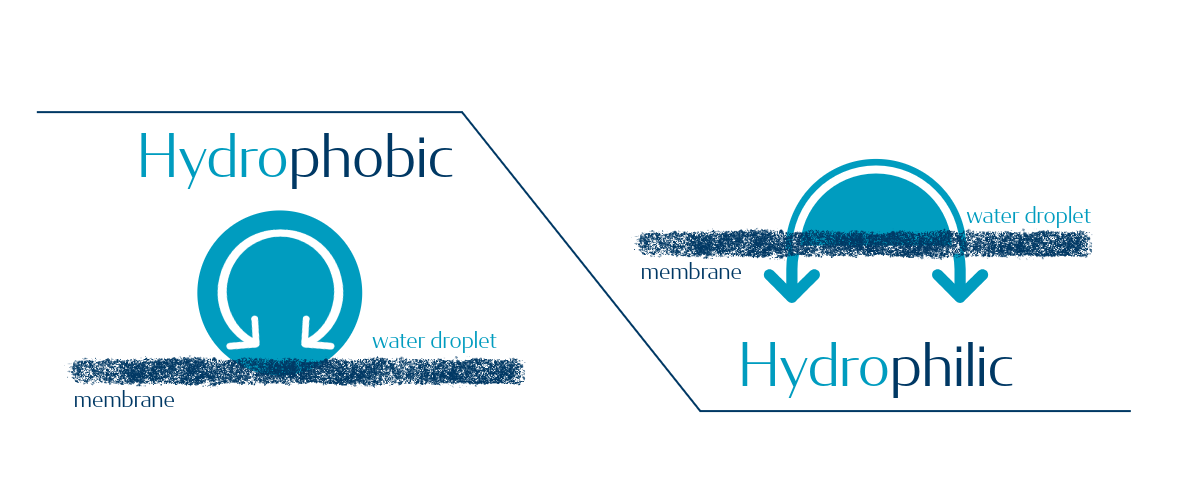
Filter elements are designed to either attract or repel water-based fluids. Hydrophilic filters allow these liquids to pass through readily, making them the standard choice for water filtration needs. Hydrophobic filters prevent these liquids from passing through while simultaneously allowing gases through, making them the filter of choice for filtering moisture out of gaseous fluids.
3. Chemical Compatibility
Fluids and fluid combinations can be highly reactive, especially when introduced to certain other materials. Are you working with organic solvents, acids, or other caustic solutions? If the answer is yes, then you probably already know what chemical compatibility looks like for you.
If your answer is no, then you might be surprised to know that even seemingly benign fluids, like basic water or fats, can be incompatible with certain other materials. Chemical incompatibility can be subtle. Water, oils, and fats can leach chemicals from your flow control components that could make them unsuitable for their intended use. This is especially likely in high heat environments.
When it comes to your inline filters, treat the filter housing and filter element separately. Their chemical compatibility needs may not be identical. Sure, they’re both coming into contact with the same internal fluid. But your filter housing may also be exposed to external temperatures that could influence the range of material options. Considerations over pressure and filter type also influence these decisions. Check out our Chemical Compatibility Chart to learn more.
4. Operating Conditions
Let’s face it, conditions vary both intentionally and unintentionally. A filter may work fine at room temperature, but fail before it reaches the boiling point of water. The filter element could blow out when up against too much pressure or particularly viscous fluid. Sometimes these conditions are predictable, as they are expected, or even necessary, parts of your system’s environment. Sometimes, they surprise you, as when cooling systems or pressure gauges fail.
When considering your filter type and materials, consider now only what can operate under your ideal conditions, but also the likelihood of certain non-ideal scenarios and what filter options may be able to weather the storm.
Ask yourself about:
- Temperature — What is the temperature of the fluid passing through my filter? What is the temperature of the space in which my system is housed?
- Pressure — What is the system pressure, and what is the expected pressure drop across the filter?
- Viscosity — How thick is the fluid passing through the filter? Will reinforcing the filter be enough to accommodate it?
- Volume — What volume will the filter need to handle? This won’t always be easy to tell, and may need testing.
- Filtration Demand — Aka particle load. How much active filtration will your filter be doing? Are we talking a consistent stream of particles or just the occasional catch?
It’s worth noting that operating conditions are closely connected to chemical compatibility and filter type. In that sense, it’s sometimes helpful to start with these questions as you explore the various materials, filter types, micron sizes, and more at your disposal.
5. Physical Connections
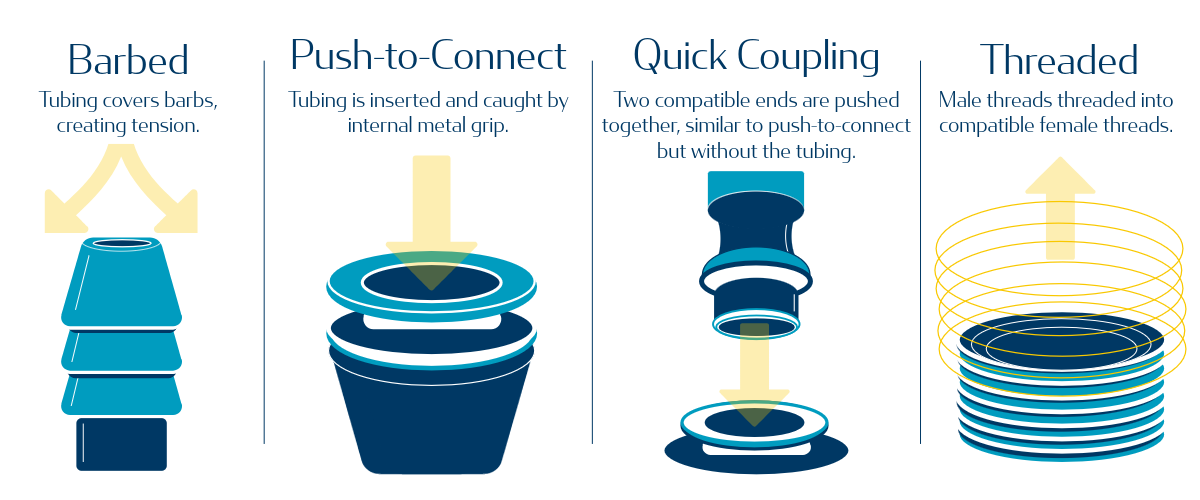
By definition, inline filters are integrated into your flow control system. They therefore need to be securely connected on either end to the tubing or other fittings in that system. The wrong connection will interrupt flow, negatively impacting efficiency at best and causing component or system failure at worst. We cover this in more detail in our article on inline filter physical connections, but here’s a general run-down of the types of connections available to you.
- Barbed connections, aka hose barbed connections, are ideal for soft tubing and provide a secure grip without the need for additional parts. They come in different diameters and with differing numbers of barbs on a single end.
- Threaded connections use classic threading technique (think the lid to your 20 oz coke bottle). They are better suited to more rigid applications, like machinery or some plumbing, that want a secure seal without the need for flexibility.
- Push-in connections essentially snap into place, making them a good option for prioritizing ease of installation and limited downtime.
- Quick Couplings, aka valved quick connections, automatically stop flow when disconnected, making changing filters easier and neater.
Remember to consider the shape of your filter fittings as well. Will it be straight-forward (literally) or angled? Finally, will it need two, three, or even four connection points? Will all these points be the same size, length, and connection type?
Considerations and Mondifications
The above considerations are fairly universal, but you may have other critical needs when it comes to selecting the right filter. For example, you may need clear housing for visual inspections, regulatory compliant materials (e.g. FDA grade plastics), or color coding by filter element pore size to prevent mix-ups.
Add all of these elements together, and suddenly the already intimidating Google search bar is feeling even less accessible. How will you find the exact membrane filter with double hose barbed connection on one side and male to female threaded connection on the other that you need for your FDA regulated application? And with so many different suppliers out there, how will you trust it when you do?
Talk to an expert who can help you cut through the noise and find the right part. Our engineers and associates will answer your questions, help you determine the right inline filter for your application, and help you find that filter, including sourcing it or modifying existing fittings if we don’t already have it in stock.
Ready to save your energy for your application? Talk to an ISM expert.

Take Advantage of Our Expertise
We offer a line of ideas, so if you don't see it - ask for it. Let us turn your ideas for pneumatic or fluidic circuitry assemblies into reality — from conception to finished product.