
Customized Tubing to Elevate Your Flow System
For many flow systems, off-the-shelf tubing simply won’t suffice. At times, applications present challenges that require custom options for a successful implementation. Adaptable tubing, custom extrusions, and clear identification give flow systems an additional layer of control and clarity. Below, we explore five options for customized tubing.
1. Bonded Tubing
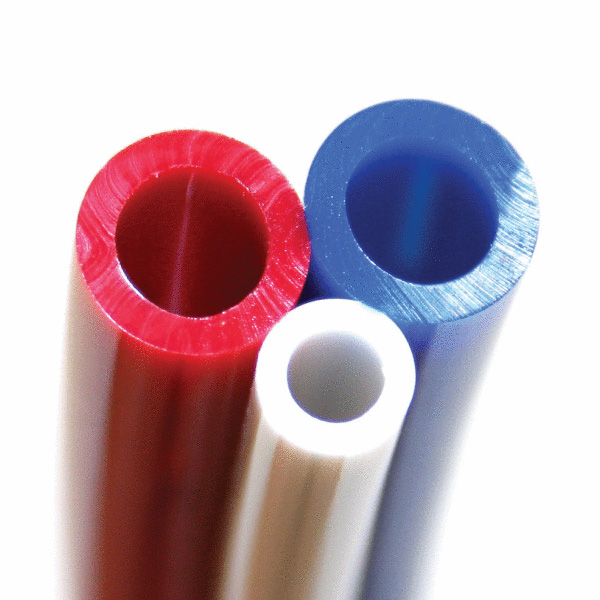 Tube bonding brings multiple lengths of tube together, creating a clean and simple method for managing a line of tubing. Bonding is a form of welding that connects the outer diameter of one tube to another, enabling multiple lines to be managed without entanglement while allowing for individual connection points. Bonded tubes of different colors provide a visual means of line tracing. Bonding a variety of plastics, such as PVC and Nylon, provides different chemical compatibility properties within a single line.
There are 3 different options for bonded tubing:
- Permanent bonding: Welds of this type offer a seal that must be cut to be separated. High-capacity and long-term jobs often need a permanent bond that allows two different tubing types to stay linked.
- Strippable bonding: This bond offers a peelable seal, allowing the tubing to be separated for routing and connection points along a main line. This type of bonding is most common for applications that utilize push-in fittings. For installation, separate the tubing as needed and connect your fittings to the now individual lines.
- Skip bonding: This form of bonding features interrupted sections of weld, resulting in unbonded areas. This creates openings in the bonded tube where fittings, filters, or other tubing can be passed through. Like strippable bonding, skip bonding makes separation of tubing straightforward for installation of fittings and individual tube routing.
2. Coextrusion
 Coextrusion in tubing is the process of combining multiple materials into one tube. Typically, this means one material lines the inner diameter wall, while another is used for the tube's exterior. For example, a tube could feature a flexible polyurethane exterior and a chemically resistant Kynar interior.
Many medical applications, like insulin delivery and pain therapy, benefit from this technology. The interior layer provides chemical resistance and maintains purity, while the exterior layer provides additional protection from cross-contamination.
3. Colors
 Tubing color plays a crucial role in organizing and identifying individual tubes within a flow system. ISM tubing is offered in 28 standard colors. Moreover, colors can be blended to achieve a desired hue by using a submitted color swatch. Colored tubing is available in a variety of materials, including nylon and PVC.
Tubing identification with color is particularly helpful in separating tubing for different purposes that are similar in material and shape. Toxic or dangerous flow systems can be clearly identified to prevent contamination, misplacement, or repair without proper safety precautions. Color coding tubing also makes system assembly and maintenance straight forward.
4. Printing
Print identification on tubing has proven helpful during system assembly and maintenance. Text color options include black or white lettering on any piece of tubing. It should be noted that text color should offer enough contrast to tubing color to ensure legibility.
Tubing systems that involve hazardous flow should use printed labels to identify safe and unsafe sections. Tubing of similar size and color can often be confused, so adding warning labels helps prevent mishaps. Tubing that is expected to be seen or sold can be printed with company branding, bringing a personal touch to your projects.
5. Sleeving
Loose tubing is difficult to manage and prone to damage. A sleeve keeps multiple tubes bundled together, easing routing throughout a system. Sleeving also provides a layer of protection and prevents kinks, to ensure that systems with movement continue to function without fear of damaged tubing.
Various sleeve materials provide options for heat and chemical resistance, as well as elasticity to accommodate a wide range of tubing dimensions. Certain rubber sleeves stretch and compress to fit into small spaces. Our production team often combines a variety of tubing materials or colors into a single sleeve and cut it to length for a specific application.
At ISM, we are committed to delivering high-quality tubing solutions that cater to your unique requirements. If you have any specific projects or questions regarding our tubing variations, please don't hesitate to reach out to us. Our team of experts is ready to assist you in finding the perfect fit for your application.